Table of Contents
Many businesses invest in advertising, publish content on social media, and drive traffic to their websites or social accounts. Yet, in the end, they still do not see a clear increase in sales.
This is where the real problem appears: it is not always about the number of visitors. It is often about how those visitors are turned into customers.
Digital marketing is not only about making your business more visible or getting more clicks and views. Its real value appears when it becomes part of a clear journey that guides the customer from the first moment of interest to the decision to contact you or buy from you.
In this article, we explain how digital marketing can help increase sales in a practical way, and what stages a visitor goes through before becoming a customer.
How Does Digital Marketing Increase Sales?
Digital marketing increases sales when it does more than attract visitors. It helps build trust, communicate the value of your product or service, and guide potential customers toward a clear action, such as requesting a consultation, sending a message, filling out a form, or completing a purchase.
In simple terms, successful digital marketing does not focus only on visibility. It connects visibility with measurable business results.
A business does not need only a good advertisement. It needs an integrated system that includes targeting, content, website experience, landing pages, marketing messages, and follow-up after the first interaction.
Why Traffic Alone Is Not Enough to Increase Sales
Getting traffic to your website or social media accounts is important, but it is not the final goal. The real goal is to turn part of that traffic into qualified leads, and then into actual customers.
You may have an advertising campaign that generates many clicks, but weak sales results. You may also have an active Instagram or LinkedIn account, but very few inquiries. In most cases, the reason is that visitors do not find a clear journey after they reach you.
These are some important questions every business should ask:
- Can the visitor understand what you offer within a few seconds?
- Does the visitor know why they should choose you instead of a competitor?
- Is there a clear call to action?
- Does your website or social profile build trust?
- Do you follow up with interested prospects after the first interaction?
If the answer is not clear, then the problem is not only the number of visitors. The real issue may be the conversion journey itself.
What Is the Customer Journey in Digital Marketing?
The customer journey is the path a person goes through from the moment they first discover your business until they decide to contact you, request your service, or buy from you.
Not everyone who sees your ad is ready to buy immediately. Some people are hearing about your business for the first time. Others are comparing you with competitors. Some need more content, more proof, or more trust before making a decision.
That is why businesses need to build a clear digital journey, not just publish random posts or run disconnected campaigns.
5 Stages That Turn a Visitor Into a Customer
The journey of increasing sales through digital marketing can be simplified into five main stages:

| Stage | Goal | Practical Example |
|---|---|---|
| Attract attention | Reach the right audience | An ad, post, article, or short video |
| Build interest | Explain the problem and the solution | Educational content or a post that answers a customer question |
| Build trust | Convince the customer of your credibility | A professional website, previous work, or client testimonials |
| Drive action | Encourage the visitor to contact you or buy | A clear button, relevant offer, or simple contact form |
| Follow up and optimize | Improve conversions and results | Retargeting, follow-up messages, and data analysis |
Stage One: Attract the Right Audience
The first step to increasing sales is not reaching as many people as possible. It is reaching the right people.
You may get thousands of views, but they will not mean much if they come from an audience that has no real interest in what you offer. That is why you need to clearly define your ideal customer from the beginning.
Questions That Help You Define Your Audience
- Who is the customer I want to reach?
- What problem is this customer facing?
- What makes them search for a solution now?
- Which platform do they use the most?
- What type of message is most likely to capture their attention?
The more accurate your targeting is, the higher the quality of your leads will be, and the less budget you will waste on the wrong audience.
Stage Two: Create Content That Explains the Problem Before Selling the Solution
A customer does not buy simply because they saw an attractive ad. In most cases, they first need to feel that the business understands their problem.
This is where marketing content plays an important role. Good content does not only talk about the company and its services. It answers customer questions, explains the problem, and helps the customer understand the value of the solution.
Examples of Content That Can Help Increase Sales
- An article that explains mistakes preventing a website from generating sales
- A post that explains the difference between website traffic and qualified leads
- A short video that discusses a common customer problem
- A case study showing how a business improved results after developing its digital presence
- A service page that explains benefits instead of only listing features
Successful content does not push the customer to buy immediately. It helps them become gradually convinced.
Stage Three: Build Trust Through a Strong Digital Presence
Before a customer contacts you, they will often search for you. They may visit your website, check your LinkedIn or Instagram profile, read your company overview, or look for examples of your previous work.
If they find an outdated website, inactive social accounts, or unclear messaging, they may hesitate even if they are interested.
A professional digital presence helps build trust through:
- A clear and fast website
- Well-structured service pages
- A consistent visual identity
- Content that reflects your expertise
- Portfolio examples or success stories
- Clear calls to action
Trust does not come from one advertisement. It comes from the complete impression a customer gets from your business across every digital touchpoint.
Stage Four: Convert Visitors Into Qualified Leads
After attracting the visitor and building interest and trust, the next step must be very clear.
What do you want the visitor to do? Do you want them to request a consultation? Send a WhatsApp message? Fill out a form? Book an appointment? Buy a product?
One common mistake is sending visitors to a page that does not provide a clear path forward. The visitor may be interested, but they do not find a strong reason or an easy way to take the next step.
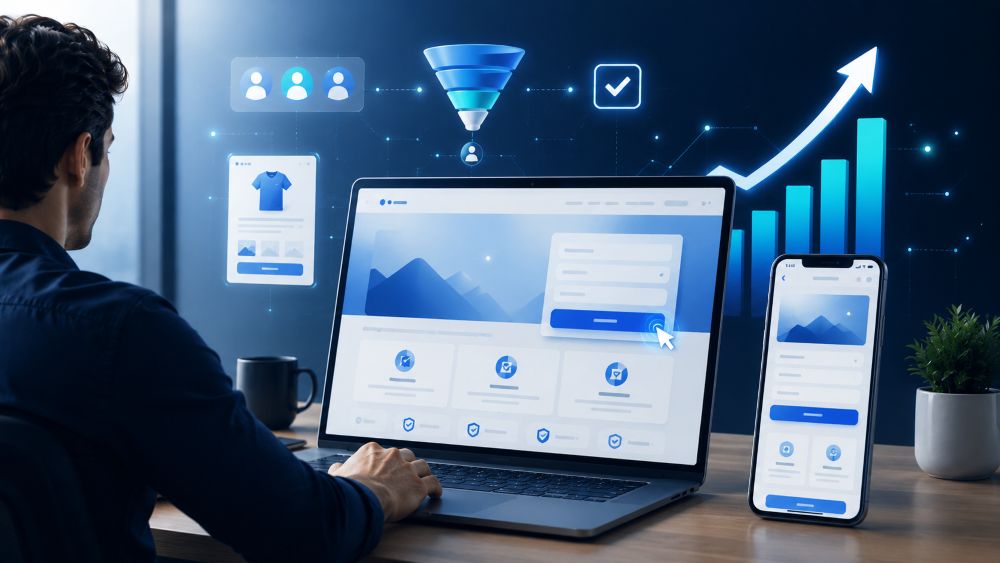
Elements That Help Improve Conversion Rate
- A clear headline that explains the value
- A visible and easy-to-access contact button
- A simple form that does not ask for too much information
- A ready-to-use WhatsApp message
- A clear and relevant offer
- Trust signals close to the contact button
- A dedicated landing page for the campaign
The easier and clearer the next step is, the higher the chance that the visitor will become a qualified lead.
Stage Five: Follow Up and Optimize

Not every potential customer will make a decision from the first visit. Some customers need time. Some compare different options. Others need an additional message at the right moment.
That is why follow-up is an essential part of increasing sales through digital marketing.
Tools That Help With Follow-Up
- Retargeting ads
- Email marketing campaigns
- WhatsApp messages for interested leads
- Content tailored to people who previously visited your website
- Landing page improvements based on performance data
Optimization depends on analyzing the right numbers, not only looking at views or clicks.
Important Metrics to Monitor
- Conversion rate
- Cost per lead
- Lead quality
- Best-performing customer acquisition channels
- Pages that generate the highest number of inquiries
- Advertising messages with the strongest performance
Without analysis, marketing becomes guesswork. With data, you can understand what should be improved, what should be stopped, and what deserves more investment.
The Difference Between Marketing That Brings Traffic and Marketing That Increases Sales
| Marketing Focused Only on Traffic | Marketing Focused on Sales |
|---|---|
| Focuses on the number of clicks | Focuses on the quality of leads |
| Publishes general content | Publishes content connected to customer problems |
| Sends visitors to any page | Sends visitors to a dedicated page |
| Measures views only | Measures conversions and results |
| Relies on a separate ad | Relies on an integrated customer journey |
How Do You Know Your Business Needs Better Digital Marketing?
Your business may need to review its digital marketing strategy if you notice any of the following signs:
- You have website traffic but not enough inquiries
- You spend on advertising without knowing the real return
- Your social accounts are active, but inquiries are low
- Customers do not easily understand your services
- You do not have a clear page for each service
- You do not know which channel brings the best customers
- You do not have a content plan connected to the customer journey
These signs do not mean that digital marketing does not work. They usually mean that the system needs to be organized and improved.
Common Mistakes That Prevent Digital Marketing From Increasing Sales
Focusing Only on Design
Design is important, but it is not enough if the message is unclear or if there is no journey that guides the customer toward a decision.
Running Ads Without a Proper Landing Page
An ad can attract the visitor, but the page is what helps them make a decision. That is why the ad cannot be separated from the experience the customer finds after clicking.
Targeting an Audience That Is Too Broad
The broader the audience is, the weaker the message usually becomes. It is better to create a message for a specific audience with a specific problem.
Not Having a Clear Call to Action
If the visitor does not know what to do next, they may leave without taking action. That is why the call to action must be clear and direct.
Not Measuring Results
You cannot improve what you do not measure. Campaigns and landing pages should always be connected to clear performance indicators.
Practical Example: From Ad to Customer
Let’s say a company offers consulting services and wants to increase the number of clients.
Instead of launching a generic ad that says, “We provide the best consulting services,” the business can build a clearer journey:
- An ad that highlights a specific customer problem.
- A landing page that explains the problem and the solution.
- Supporting content that answers common questions.
- A simple form to request a consultation.
- A follow-up message for interested prospects.
- Retargeting for people who visited the page but did not contact the business.
In this way, the ad is not separate from the rest of the marketing process. It becomes part of a journey that guides the customer step by step.
How HexaGoal Helps Businesses Increase Sales Digitally
At HexaGoal, we look at digital marketing as an integrated growth system, not just as post design or advertising campaigns.
We help businesses improve their digital presence through:
- Building a marketing strategy suited to the sector and audience
- Developing marketing content and social media presence
- Designing websites and landing pages that support conversions
- Improving marketing messages and offers
- Supporting advertising campaigns with a clear structure
- Analyzing results and improving the customer journey
The goal is not only for the business to appear more online. The goal is for that visibility to create stronger communication, more trust, and better sales opportunities.
Do you want to turn your digital presence into a real source of customers?
Explore HexaGoal’s digital marketing services and discover how we help businesses turn online visibility into real sales opportunities.
Conclusion
Increasing sales through digital marketing does not happen simply by publishing more content or spending a larger advertising budget.
Real results begin when there is a clear customer journey, a relevant message, a website or landing page that supports conversion, and continuous follow-up based on data.
In many cases, the problem is not the number of visitors. The problem is the absence of a system that turns those visitors into customers.
So, if your business is getting visibility or traffic without clear results, it may be time to review your digital customer journey and turn your marketing from scattered activities into an integrated growth system.
Frequently Asked Questions About Increasing Sales Through Digital Marketing
Does digital marketing increase sales directly?
Yes, digital marketing can help increase sales when it is based on a clear strategy and an integrated customer journey, not just separate posts or advertising campaigns.
What is the most important factor in increasing sales through digital marketing?
The most important factor is having a clear customer journey, from the first interaction with the brand to the moment of contact or purchase.
Are ads alone enough to increase sales?
No. Ads help attract visitors, but they need a proper page, a clear message, supporting content, and follow-up in order to turn visits into customers.
Why do I have a lot of traffic but no sales?
The reason may be a weak landing page, an unclear offer, targeting the wrong audience, the absence of a clear call to action, or not enough trust before the purchase decision.
How do I start improving sales digitally?
Start by analyzing your current customer journey: where does the visitor come from, what do they see, what message do they receive, what is the next step, and where do they stop before becoming a customer?