Table of Contents
Artificial intelligence has become an important part of design, marketing, and content creation today. Its use is no longer limited to writing text or answering questions. It can now suggest website designs, generate images, write page content, improve headlines, and even suggest a complete website structure in a short time.
This development has made many business owners ask: Can I design my entire website using artificial intelligence? Do I still need a designer, developer, or specialized team if smart tools can produce ideas and designs quickly?
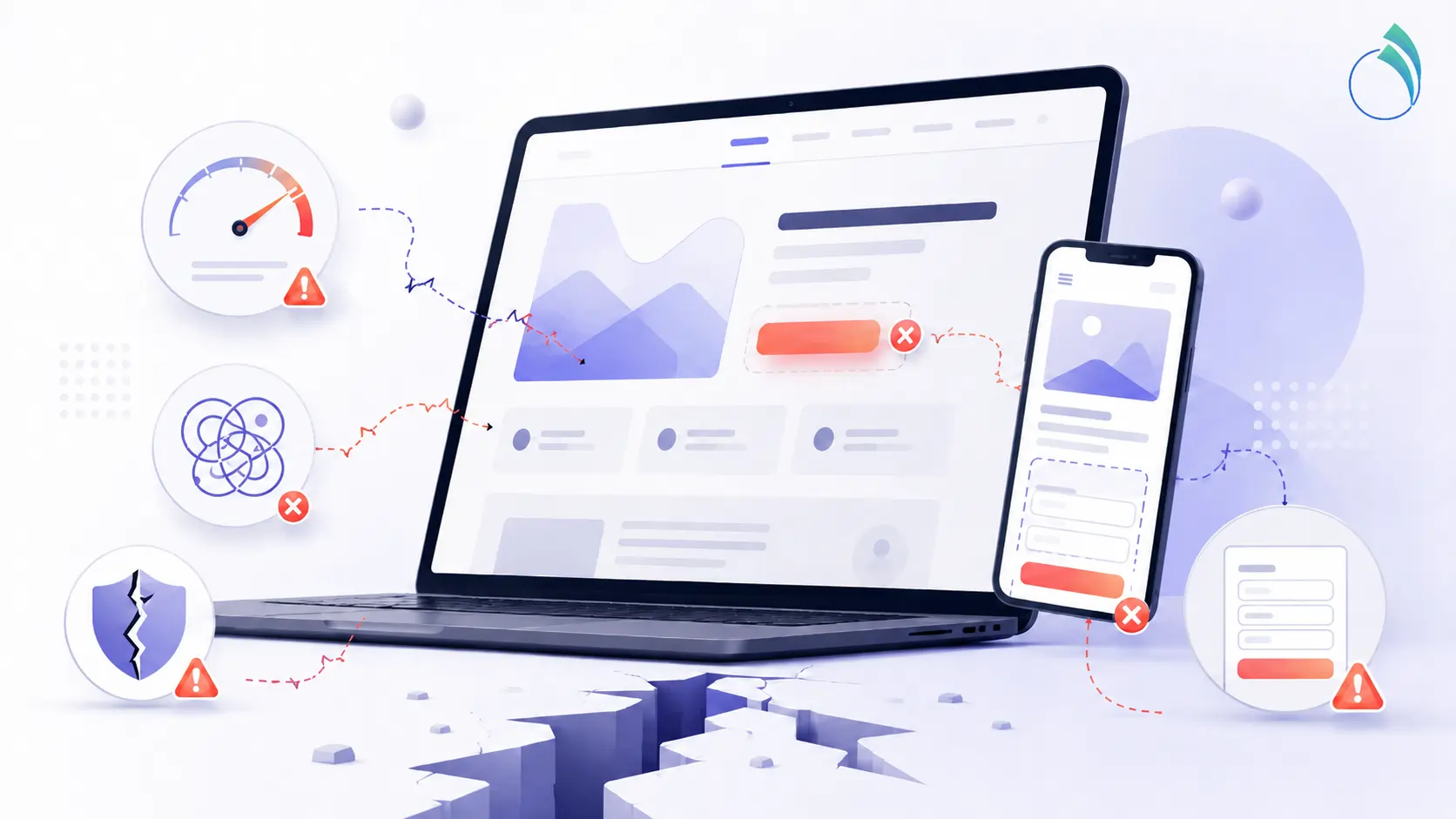
The answer is not simply yes or no. Artificial intelligence is a powerful and very useful tool, but it is not enough on its own to build a successful professional website. It can save time, help organize ideas, and provide excellent drafts, but it cannot fully understand the nature of a project, test the user experience, guarantee technical implementation quality, or build a clear website strategy by itself.
This also includes UI/UX, which means user interface design and user experience design. These elements are not only about appearance, but also about ease of use and how clear the visitor’s journey is inside the website.
In simple terms: artificial intelligence helps you start faster, but it does not guarantee a successful website without planning, experience, and proper implementation.
Why Has AI Website Design Become an Attractive Idea?
The main reason is that artificial intelligence gives an impression of speed and ease. A business owner who wants to launch a new website may find tools that promise to design a full page or write website content within minutes.
This sounds very attractive, especially for small businesses or new projects that want to reduce costs and launch faster.
In the past, building a website required several long stages, starting with planning, then content writing, then design, development, and testing. Today, artificial intelligence can help with some of these stages very quickly. For example, it can suggest website sections, write an initial service description, prepare homepage ideas, or even generate a visual concept for how the website could look.
But the problem begins when artificial intelligence becomes a full replacement for thinking and experience instead of being a supporting tool, because a website is not just a beautiful page or organized text. It is an official face for the business, a marketing tool, and a trust point between you and the potential customer.
What Can Artificial Intelligence Do in Website Design?
Artificial intelligence can be useful in many stages of building a website, especially at the beginning when ideas are not organized, or when the business owner needs a general vision before starting implementation.
For example, it can be used to suggest the website structure. If you have a business and do not know which pages you need, artificial intelligence can suggest pages such as Home, About Us, Services, Workflow, FAQ, and Contact.
These suggestions help you see the general picture of the website before going into design details, but they do not mean that every website should have the same pages. The needs of a service company website are different from the needs of an online store, and the needs of a personal website are different from the needs of a large organization.
Here are some examples of what artificial intelligence can help with during website creation:

- Suggesting homepage sections.
- Writing initial content drafts.
- Improving headline wording.
- Preparing ideas for images or graphics.
- Writing service-related FAQ questions.
- Suggesting blog article ideas.
- Suggesting initial SEO keywords.
These are examples, not a complete list of everything that can be done. The value of artificial intelligence depends on how it is used, the quality of information we give it, and the experience of the person who reviews its outputs and turns them into a suitable result.
It can also help with writing initial text. Instead of starting from a blank page, it can generate a draft for the company overview, service descriptions, section titles, or call-to-action messages such as Contact Us or Get a Consultation.
However, these texts should remain drafts that need review and editing, because they are often general, may not accurately reflect the company’s personality, may not use the right language for the target audience, or may not highlight the real strengths of the business.
Where Is Artificial Intelligence Not Enough on Its Own?
Although artificial intelligence is useful, it cannot replace everything. A successful website needs accurate decisions that do not depend only on generating text or images. It depends on understanding the project, the audience, the market, and the business goal behind the website.
The first weakness that appears when relying completely on artificial intelligence is that its outputs can sometimes be general. It may write a nice text about a company that provides digital services, but that same text could fit dozens of other companies.
The problem here is that the website loses its uniqueness. The visitor does not want to read general words only. They want to understand why they should choose you specifically, what makes your service different, and what value they will get if they contact you.
Also, artificial intelligence only knows the details of your project based on the information you give it. If the information is incomplete, the result will be incomplete. If the instructions are unclear, the output will not be accurate.
Some areas need human review and practical experience, for example:

- Testing the website on mobile and desktop.
- Making sure buttons work correctly.
- Connecting contact forms to email.
- Improving page loading speed.
- Adjusting SEO settings inside the website.
- Making sure pages can be indexed.
- Protecting the website from technical errors and issues.
- Reviewing translation in multilingual websites.
These examples show that artificial intelligence can help with thinking and preparation, but it does not replace proper implementation and careful review.
A Website Is Not Just a Beautiful Design
One common mistake is thinking that a successful website is only the one that looks beautiful. Yes, appearance is important, and the first impression has a strong effect, but beauty alone is not enough.
This is where UI/UX becomes important. A good user interface makes the website visually organized and clear, while a good user experience helps visitors reach what they want easily and without confusion.
Although artificial intelligence can suggest good ideas for interface design, it remains limited compared to human experience in UI/UX. It does not actually test visitor behavior, and it does not always know how users interact with a page, where they may stop, or what might make them leave the website. This is why reviewing the user experience, arranging elements, testing buttons, and checking the browsing path still need a human eye and practical experience.
You may visit a website that looks very beautiful in terms of colors, images, and animations, but you do not quickly understand what the company offers. You may find that the contact buttons are unclear, the text is long and distracting, the website is slow, or it does not work well on mobile.
In this case, the beautiful design did not serve the real goal. It may even become an obstacle if it distracts the visitor or makes reaching information more difficult.
A successful website should quickly answer the visitor’s questions, such as:
- Who are you?
- What do you offer?
- Why should the customer trust you?
- How can they contact you?
- What is the next step they should take?
If these questions are not clear, the website needs improvement, even if it looks attractive.
Therefore, when building a website, it should be viewed as a business tool, not just a design board. A good website helps you present your services clearly, build trust, receive potential clients, support advertising campaigns, and improve your visibility in search engines over time.
When Is Using Artificial Intelligence Useful in Building a Website?
Using artificial intelligence is excellent when it is placed correctly within the website building process. It is not a complete replacement for the designer or developer, but it is a powerful assistant that can make the work faster and more organized.
In the planning stage, artificial intelligence can help you organize ideas. If you do not know what should be on the homepage, how to explain your services, or how to arrange website sections, it can give you useful suggestions to start from.
In the content stage, it can write initial drafts. These drafts can be a very good starting point, especially if the business owner does not know how to describe their services in a clear or marketing-friendly way.
In the design stage, it can suggest visual directions and page ideas, such as imagining a homepage for an accounting firm, a marketing agency, a real estate company, or a medical clinic.
Artificial intelligence can be used effectively in several stages, such as:
- The planning and idea organization stage.
- The initial content writing stage.
- The design direction suggestion stage.
- The page title improvement stage.
- The blog idea preparation stage.
- The customer FAQ suggestion stage.
However, it is important to review and edit the text so that it becomes more accurate, realistic, and close to the company’s voice. The right text is not only beautiful text. It is text that explains the service clearly and convinces the visitor to take the next step.
In the SEO stage, artificial intelligence can suggest titles, articles, and initial keywords. But it cannot guarantee search engine visibility on its own, because SEO needs proper on-site implementation, good speed, ongoing content, internal linking, and a good user experience.
In other words, the best use of artificial intelligence is to make it an assistant in thinking and production, not the final decision-maker for everything.
When Should You Not Rely on Artificial Intelligence Alone?
It is not recommended to rely on artificial intelligence alone when the website is important for your business. If the website is just a test or a simple personal page, relying on ready-made tools may be acceptable at the beginning.
But if the website represents a company, service, or brand, it is better to build it in a more professional way.
For example, if the website will receive requests from potential customers, it is not enough for the page to be beautiful. The visitor journey must be clear from the first moment, so the visitor understands the service, its benefit, how to contact you, and why they should trust you.
Also, if the website is multilingual, relying on artificial intelligence alone may cause problems. The translation may be correct in meaning, but it may be too long and break the design, may not suit the Arabic page direction, or may use expressions that are not familiar to the target audience.
Some cases need more attention, for example:
- Official company websites.
- Service websites that receive requests.
- Multilingual websites.
- Online stores.
- Landing pages for advertising campaigns.
- Websites that need continuous visibility on Google.
- Websites that include contact forms, bookings, or client portals.
These are common examples, not a full list of all cases. They show that the importance of the website and its role in the project determine the required level of professionalism.
The Difference Between Designing a Website and Building a Successful Website
There is a big difference between designing a website and building a successful website. Design is part of the work, but it is not the whole work.
Design focuses on appearance, while building a successful website combines appearance, content, technology, speed, SEO, and user experience.
You may have a beautiful design that does not achieve any result, and you may have a simple website that is clear, convincing, and brings you customers.
Therefore, a website should not be judged by its appearance only, but by its performance, clarity, and ability to serve the project’s goal.
A successful website should be organized. When the visitor enters the homepage, they should feel that the information is arranged naturally. They start by understanding the service, then see what makes you different, then learn how the process works, and then find an easy way to contact you.
Some elements that help turn a website from just a design into an effective tool include:
- A clear main message at the beginning of the page.
- Sections arranged according to the visitor’s information needs.
- Visible and understandable contact buttons.
- Images that support the idea and do not distract the visitor.
- Good loading speed.
- Excellent mobile compatibility.
- Internal links between important pages.
These elements are not everything, but they show the difference between a website that was created quickly and a website that was planned carefully.
Can a Business Owner Build a Website by Using AI?
Yes, a business owner can start by themselves, especially if they want an initial test or a simple website. Modern tools have become easier than before, and artificial intelligence can help reduce confusion at the beginning.
But it should be clear that building a website by yourself does not necessarily mean you will get a professional result from the first attempt.
You may be able to create pages, add text, choose a template, and arrange some sections, but the final quality of the website depends on many details.
Before relying on the website, you should review questions such as:
- Are the texts clear and convincing?
- Is the section order logical?
- Is the website fast?
- Does it work well on mobile?
- Do the contact forms send messages correctly?
- Are the pages prepared for SEO?
- Does the design reflect the required level of trust?
If the project is in a very early stage, a simple website can be a good start. But when the project starts receiving clients, running ads, or building a brand, it becomes better to invest in a more professional website.
Practically speaking, a business owner can use artificial intelligence to prepare ideas and initial content, then work with a specialist to implement and improve the website.
This approach combines speed and reasonable cost on one side, and quality and experience on the other.
Does Artificial Intelligence Replace the Role of Website Designers and Developers?
Artificial intelligence does not eliminate the role of the designer or developer, but it changes the way they work.
In the past, a large part of the time was spent on repetitive tasks, such as writing drafts, searching for ideas, or testing different headline formats.
Today, artificial intelligence can speed up these tasks significantly. This allows the designer or developer to focus more on the most important aspects.
But the designer or developer does not only provide implementation. Their real role is to understand the goal and turn it into a clear experience.
They decide what should appear first, what can be delayed, how the page should be arranged, how the button can become clearer, how the website can be improved for mobile, and how forms and links should be tested.
The developer also handles things that the visitor usually does not see, but they are very important, such as hosting setup, performance optimization, plugin configuration, fixing design conflicts, website protection, and making sure pages work correctly.
Therefore, artificial intelligence makes the specialist faster and stronger, but it does not remove the need for experience.
In fact, the best results come when a specialist uses artificial intelligence wisely, then adds their experience in design, development, and marketing.
How to Use Artificial Intelligence Correctly When Designing Your Website
The best way to use artificial intelligence is to start with a clear goal.
Do not start with the question: How can I make the website beautiful? Start with a more important question: What do I want the website to achieve?
Some questions that help you define the goal of the website include:
- Do you want people to know your company?
- Do you want to receive requests?
- Do you want to sell products?
- Do you want to book appointments?
- Do you want to support advertising campaigns?
- Do you want to appear on Google?
Each goal needs a different way of building the website.
After that, define your audience. The way you speak to companies is different from the way you speak to individuals. A service website is different from an online store, and a marketing agency website is different from a clinic or accounting firm website.
Then use artificial intelligence to get drafts and ideas. Ask it to suggest the website structure, then edit it. Ask it to write service content, then review it. Ask it for homepage ideas, then choose what suits you.
After that comes the implementation stage. This is where ideas must be turned into a real website that works well.

This stage includes important tasks such as:
- Building the pages.
- Adjusting the design.
- Improving the mobile experience.
- Connecting forms.
- Setting up SEO.
- Improving speed.
- Testing everything before launch.
Finally, do not consider launching the website as the end of the work. A website needs continuous development. You can add articles, improve pages, monitor performance, review keywords, and update content as the project grows.
What Does a Professional Website Really Need?
A professional website does not depend on one element only. It is not enough for the design to be modern, the content to be long, or the images to be beautiful.
Success comes from several elements working together.

A Clear Identity
A website needs a clear identity. Colors, fonts, images, and presentation style should reflect the nature of the project. For example, a legal company website needs a sense of trust and seriousness, while a marketing agency website needs energy, clarity, and creativity.
Clear Content
A website needs clear content. The visitor does not want to read complicated words or very general statements. They want to quickly understand the service, its benefit, and what makes it suitable for them.
A Comfortable User Experience
A website needs a comfortable user experience. Pages should be easy to browse, buttons should be clear, the menu should be organized, and the contact method should be simple.
Good Performance and Speed
A website needs good performance. Loading speed is very important, especially on mobile. A slow website may cause visitors to leave before they even see the content, and it may also affect the website’s performance in search engines.
A Correct SEO Foundation
A website needs a correct SEO foundation. This includes page titles, meta descriptions, internal heading structure, image alt text, internal links, and the sitemap.
Other important points to pay attention to include:
-
-
- Clarity of the main message on the first screen.
- A clear call to action.
- Mobile compatibility.
- Having a Privacy Policy page.
- Testing contact forms.
- Connecting the website to analytics tools.
- Submitting the sitemap to Google Search Console.
- Reviewing links and buttons before launch.
These are examples of important elements, and priorities may differ depending on the type and goal of the website.
What Is Better: AI Only or a Specialized Team Only?
The best option is not one or the other in an absolute way. The best option is to combine both correctly.
Artificial intelligence provides speed and flexibility. It can prepare many ideas in a short time, help the team produce content, and expand creative options.
But the specialized team adds experience, selection, implementation, review, and testing.
If you rely only on artificial intelligence, you may get a fast result, but it could be general or incomplete.
If you ignore artificial intelligence completely, you may spend more time on tasks that could have been completed faster.
Therefore, the best solution is to use artificial intelligence as a tool inside a professional process.
In modern website projects, artificial intelligence can be part of planning, writing, and idea generation, while the specialized team turns these ideas into an organized, fast website that matches the project’s goal.
Conclusion: Is AI Enough to Design a Professional Website?
There is no doubt that artificial intelligence is a powerful and useful tool in website design.
It can help with planning, content writing, section suggestions, idea generation, and improving some SEO elements.
But it is not enough on its own to build a professional website if the goal of the website is to represent a company, attract clients, support advertising campaigns, or build long-term trust.
A successful website needs more than fast generation. It needs a clear understanding of the project, logical content structure, comfortable design, proper technical implementation, mobile compatibility, good speed, and a basic SEO foundation that helps the website appear and grow.
Therefore, artificial intelligence can be described as an excellent beginning, but not the final step.
It helps you produce ideas quickly, but experience is what chooses the best ideas, edits them, implements them, tests them, and turns them into a website that truly serves your project.
At HexaGoal, we believe that the best websites are not built by appearance alone, and not by tools alone. They are built by combining strategic thinking, clear design, professional implementation, and modern tools such as artificial intelligence when they add real value to the project.
If you are thinking about creating a website for your company or improving your current website, the most important thing is not to start with the question: How can I make my website beautiful?
Start with this question instead: How can I make my website clear, trustworthy, fast, and useful for my customers?
-
Are You Thinking About Creating a Professional Website?
If you want a clear, fast website that matches your business goals, the HexaGoal team can help you turn your idea into a practical website that reflects your identity and serves your customers.